The first time I was invited to attend a Maundy Thursday service over thirty years ago, I had no clue what it was. I understood Palm Sunday, Good Friday, and Easter Sunday. What was Maundy Thursday?
I had to experience it first-hand to understand its true meaning.
Holy Thursday
Maundy Thursday, also called Holy Thursday, recalls the events that happened the next day after the traditional Passover meal. Maundy Thursday took place in the Upper Room between Jesus and His disciples (John 13-14). It marks when Jesus was betrayed by Judas for thirty pieces of silver.
However, many other significant events happened, as well. The gospels of Matthew, Mark, and Luke reveal how Jesus Christ instituted the Lord’s Supper (holy communion) for the first time. That life-altering table of forgiveness laid out for us by the Son of God.
Some refer to the Lord’s table that evening as Jesus’ Last Supper. However, churches around the globe still celebrate Communion with the words of institution, unleavened bread, and wine. Through the power of the Holy Spirit, it was by no means Jesus’ last supper served to His disciples (you and me).
John’s Gospel Focuses on Something Different
The gospel of John hones in on Jesus’ final teachings to His disciples — this band of men who had followed Him, served Him and witnessed three years of Jesus’ ministry.
The Apostle John realized that those who know their remaining time is short choose words carefully to ensure only the essential gets conveyed. The word maundy is derived from the Latin word mandatum novum, meaning “new commandment.” So, what did Jesus’ command convey that night?
“A new commandment I give to you, that you love one another: just as I have loved you, you also are to love one another” (John 13:34).
Serving Jesus Requires Love
John doesn’t simply end his account with men enjoying a meal and hearing Jesus speak. He tells how Jesus dramatically punctuated His words with action.
In a shocking turn of events that almost sent Peter over the edge, Jesus — Son of Man in the flesh — stooped to wash the feet of His disciples. Including Judas Iscariot. (A good thing to keep in mind the next time we have trouble extending forgiveness.)
Jesus’ last night gathered with His disciples before Good Friday conveyed His pure love for them and all of us. Yet as His prayer in the Garden of Gethsemane would reveal later that evening, the self-giving love of our Lord Jesus reigned supreme.
Out of all of the Passover lambs, His blood alone would keep us safe in our Father’s arms for all eternity.
Serving Jesus Requires Serving Others
We can opt to serve others from a safe distance by sending money or supplies. However, serving to make a kingdom impact as His hands and feet require us to get in close. Get your hands dirty. Get on your knees and pray. Do the lowliest job.
That’s what foot washing represented in Biblical times. Only the lowest servant was relegated to the task of washing feet encased in sandals and thick desert dust. The job stunk. Literally. Yet Jesus bent low to wash the disciples’ feet.
That’s where Jesus meets us on Maundy Thursday — in the middle of our smelly lives.
Maundy Thursday Reflects God’s Faithful Love
He washes our feet in love and welcomes us to His table of forgiveness. And as we draw close, we hear Him remind us of His mandatum novum: “Love one another, just as I have loved you.”
The heart of Maundy Thursday reflects the heart of God: love. There is no greater love!
Love instituted in a holy meal of forgiveness and redemption.
God’s love demonstrated by a foot washing, life-giving love.
Bottom Line
If you have the opportunity to attend a Maundy Thursday worship service, don’t miss out. Listen to the beautiful message of God’s everlasting love for us. Receive Christ’s body and blood with awe and wonder at the new life we have in Him alone.
{Some of these links are affiliate links. This means if you purchase through that link, the ministry may receive a small commission at no extra cost to you.}
Go to the village ahead of you, and as you enter it, you will find a colt (donkey) tied there, which no one has ever ridden. Untie it and bring it here. If anyone asks you, “Why are you untying it?” tell him, “The Lord needs it.” (Luke 19:30-31).
That donkey did not do anything special. He was simply chosen. Then he obeyed a very simple instruction: follow where the master led.
“They brought it to Jesus, threw their cloaks on the colt and put Jesus on it” (Luke 19:35).
Scripture does not say anything else about that particular donkey. We do not see where the donkey felt that his time in the spotlight was long overdue. Or that he deserved the pomp and circumstance of that occasion. No donkey selfies.
The donkey realized that it was not about him.
It was about the Messiah that he carried: the Word who became flesh to dwell among us.
It was about the message that the Messiah came to tell: the Light of the world who came to shine hope into our darkness.
In a world obsessed with fame we need to be the donkey.
When we grab after our own glory or fifteen minutes of fame, it is helpful to remember that we are just message-carriers. The picture frame and spotlight belong only on the One who gave us the message to share: “For God so loved the world that he gave his one and only Son, that whoever believes in Him shall no perish but have eternal life” (John 3:16).
As we enter Holy Week today with Palm Sunday, it is vital to remember our place in the story: to hold the spotlight on Jesus. To shine the light on what He accomplished for us on the cross.
We need God-given willingness to let Him untie us from the mundane to carry His extraordinary message wherever He leads us.
The story of Easter is not about us.
We did not do anything special.
By God’s grace, we are simply chosen.
And He asks us to obey a very simple instruction: Follow Me.
We are conduits of the message – not seekers of the spotlight.
Once again, the darkened wee hours are startled awake as “Code Blue!” rings loud over the hospital’s ICU intercom. The staff rushes as one to battle the emergency.
I selfishly thank God that they are not rushing into mom’s room.
It’s 3am as I hear them working to save a life. As my prayers ascend each time Code Blue rings out, I know that God is already in each room.
God was in mom’s room before we were, as well. And He will be there after we are gone, whether the inhabitants acknowledge Him or not.
Prayer moves the heart of God, but faith reminds us that God is already moving.
The season of Lent begins this week with Ash Wednesday. Isaiah 53:5 tells us, “He was wounded for our transgressions, He was crushed for our iniquities; the chastisement for our peace was upon Him, and by His stripes we are healed.”
Jesus was crushed for our sin. And the most amazing thing? He did it willingly. He deliberately put Himself in harm’s way to save our lives – literally.
God positioned Jesus in a certain place and time to be the Savior of the world. Before Jesus’ sacrifice on the cross, we were in a spiritually life-threatening situation.
We weren’t going to make it out alive.
We were bleeding to death in our sin.
We were going to lose the fight for life.
But because our Savior stepped in to take God’s wrath on our behalf, we have been extended the extraordinary promise to have eternal life.
If you would like to ponder more deeply the ultimate sacrifice that Jesus made for you and me, you can download my 4-lesson Bible study on Isaiah 53:5.
“It happened, late one afternoon, when David arose from his couch and was walking on the roof of the king’s house, that he saw from the roof a woman bathing; and the woman was very beautiful” (2 Samuel 11:2, ESV).
Old Testament: King David’s Sin of Adultery
He was supposed to be out with the army. That’s what 2 Samuel 11:1 says about King David. But he decided to stay home.
He took a stroll along the rooftop and saw a beautiful young woman taking a bath. And he decided was “all in.” The rest, as they say, is history.
David lusted. Bathsheba succumbed, even though she was a married woman. David had Bathsheba’s husband Uriah murdered so he could marry her. Their sexual relationship resulted in a child. But God did not forget what took place. The price of David’s sexual immorality was the death penalty for their child.
The Collateral Damage of Adultery
So much collateral damage from one person’s act of adultery. David mistakenly thought that defiling Bathsheba’s marriage bed was above the reproach, law, or reprimand of a king.
Are you and I any different when we believe we have ultimate sovereignty over our own lives?
Adultery plagues our world today. The Ten Commandments are treated as suggestions. Whether we know a family member or friend who has suffered a wayward spouse, infidelity will likely affect every human being at one point or another.
Teachers feel the effects and consequences of adultery in their classrooms. Kids tend to act out or their grades suffer as they process the emotional hurricane caused by their parents’ divorces. Pastors’ and counselors’ schedules stay full as they walk the victims of adultery toward God’s healing.
I do not use the word “victim” lightly. That is what adultery feels like. I know. My ex-husband was a repeat offender. The one person to whom you opened your heart, body, and mind decided on some level that you were insufficient. Whether that insufficiency stems from within or is persuaded from without, it decimates intimacy. And it decimates marriages.
What is the Definition of Adultery?
Although spiritual adultery certainly happens, I am specifically talking about sexual sins. Webster defines adultery as: “voluntary sexual intercourse between a married person and someone other than that person’s current spouse.”
If you have been the victim of adultery, you struggle with your identity in the world. Discarded. Less than. Not good enough. Those labels kept me up some nights. Yet Christ Jesus has given us a much more beautiful identity. Take time to memorize these Bible verses:
“But to all who did receive him, who believed in his name, he gave the right to become children of God” (John 1:12, ESV).
“See what kind of love the Father has given to us, that we should be called children of God; and so we are. The reason why the world does not know us is that it did not know him. Beloved, we are God’s children now, and what we will be has not yet appeared; but we know that when he appears we shall be like him, because we shall see him as he is” (1 John 3:1-2, ESV).
Since our identity is in Christ, extending forgiveness to someone who has committed adultery is not optional.
So How Do We Begin the Process of Extending Forgiveness?
Forgiving the deep betrayal of adultery seems impossible. It is perfectly normal to ask God how you even begin such a daunting process. Your life just exploded and all you can see is the debris. That’s when professional Christian counselors become vital.
When our emotions are screaming for vengeance, entertaining thoughts of forgiveness seems impossible. We want to cast the first stone. We may be tempted to inflate the circumstances and bear false witness.
But as God’s children, with the Spirit of our God dwelling inside of us, we understand that we do not operate in our own strength:
“But they who wait for the Lord shall renew their strength; they shall mount up with wings like eagles; they shall run and not be weary; they shall walk and not faint” (Isaiah 40:31, ESV).
Holding on to unforgiveness creates a cage of anger and bitterness around our hearts. Taking the first step toward forgiving that betrayal is the first step to unlocking that cage toward freedom.
Adultery: One of the Hardest Acts to Forgive
Adultery ranks among the top significant hurts that are the most difficult to forgive. In fact, getting over such thing took me a solid year of counseling. Yet through the power of the Holy Spirit during that difficult time, God’s steadfast love won and forgiveness was extended.
If your marriage ended in divorce as a result of your spouse’s adultery and you are contemplating a second marriage, ensure that you have truly forgiven your ex-spouse. Otherwise, you will carry all of that ugly baggage, hurt, and bitterness into a new relationship. And that’s a recipe for disaster.
The same goes for an ex-boyfriend or ex-girlfriend if you have engaged in premarital sex. If you are considering a new marriage (or getting married for the first time), the consequences of your ex’s lack of self-control will cause you to be suspicious of any future spouse.
New Testament: What Did Jesus Say About Forgiveness?
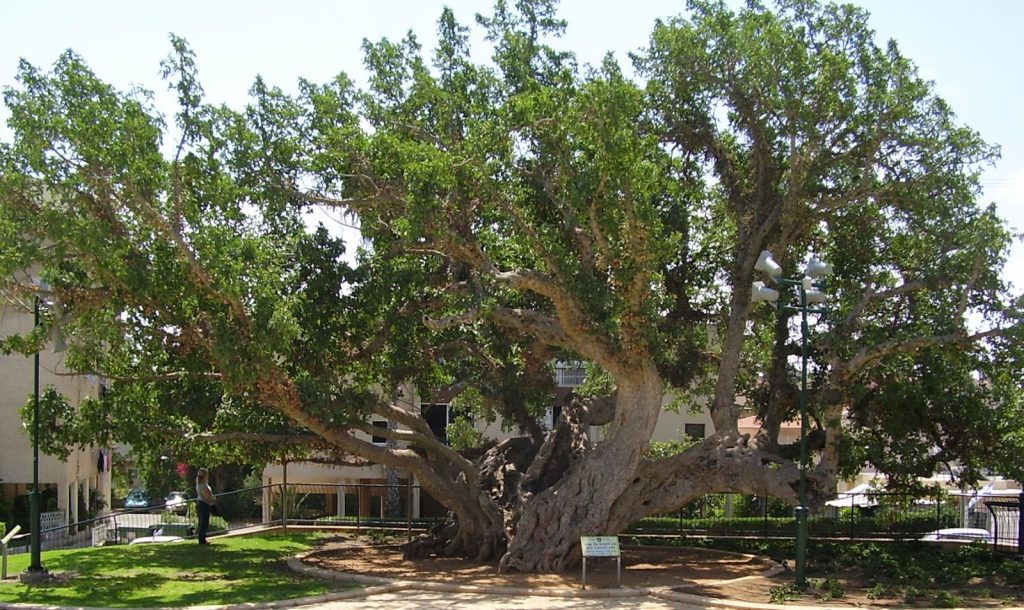
As Jesus was walking with His disciples in Luke 17, He paused by a sycamine tree to make a specific point about forgiveness. Why should we care about this tree and what does it have to do with forgiveness?
And the Lord said, If ye had faith as a grain of mustard seed, ye might say unto this sycamine tree, Be thou plucked up by the root, and be thou planted in the sea; and it should obey you” (Luke 17:6, KJV).
The sycamine tree had a robust root structure that plunged deep into the desert soil to tap into underground water sources. Because of its deep roots, drought or sheering it off at the base posed little threat. It was incredibly difficult to eradicate once established. It would inevitably resurface.
Scripture talks about not allowing any bitterness to take root in our hearts because eradicating unforgiveness is incredibly difficult. It grows deep, watered by any offense that lies hidden in the soil of our hearts.
Left alone, unforgiveness will establish deep roots and produce bitter fruit that surfaces through angry thoughts, words, and deeds.
But there is more. Much more.
The Sycamine Tree and Unforgiveness
The spiritual parallels between unforgiveness and the properties of the sycamine tree are chilling.
Wood from the sycamine tree was the preferred material for building coffins and caskets.
Sycamine trees grew quickly and were readily available in many places. In fact, Egyptian archaeologists have discovered small boxes made from sycamine wood at the base of mummified sarcophagi. These sycamine boxes remained uncorrupted for at least 3,000 years.
Unforgiveness remains in us, corrupting our hearts and mind until we allow God access to eradicate it.
The sycamine tree was only pollinated by wasps.
The wasp stuck its stinger into the heart of the fruit to initiate the pollination process. The tree had to be “stung” in order to reproduce. Think of how many times you have heard someone say, “I’ve been stung by that person once, but I’m not going to be stung like that again!”
You can almost see the poison of unforgiveness pollinate every bitter word they utter. Can you hear the pounding of the casket maker’s hammers?
Finally, the sycamine tree was planted where two paths met.
Its large trunk and stout branches offered shade to travelers as they paused to decide which path to take. When you and I get hurt – emotionally, mentally, or spiritually – we stand at a crossroads.
We Have a Choice
We have the choice between the dark, burdensome spiritual death sentence of unforgiveness or the Son-drenched, freeing path of forgiveness. The choice really is ours.
As children of the living God, we must believe that the process of eradicating bitter roots is never a hopeless endeavor. Jesus told His disciples in Luke 17:6 that uprooting unforgiveness is possible if a person has the faith of a grain of mustard seed.
In Him is our only hope of freedom from destructive bitterness: “For by grace you have been saved through faith. And this is not your own doing; it is the gift of God” (Ephesians 2:8, ESV).
Since that gift of hope that the Apostle Paul talks about comes from God we have access to an abundant, unlimited supply of the poison’s antidote.
If you have ever signed a certificate of divorce, worn the label “divorced woman” or “divorced man”, the name of the Lord Jesus Christ and the blood He shed to redeem us gives us new life – eternal life. He alone is our best friend. In the kingdom of God, we wear the label, “redeemed.”
Regardless of how deep the hurt or how long we have let it reside, it is never too late to surrender our unforgiveness to God for permanent eradication.
In God’s hands, the casket maker’s career is short-lived.
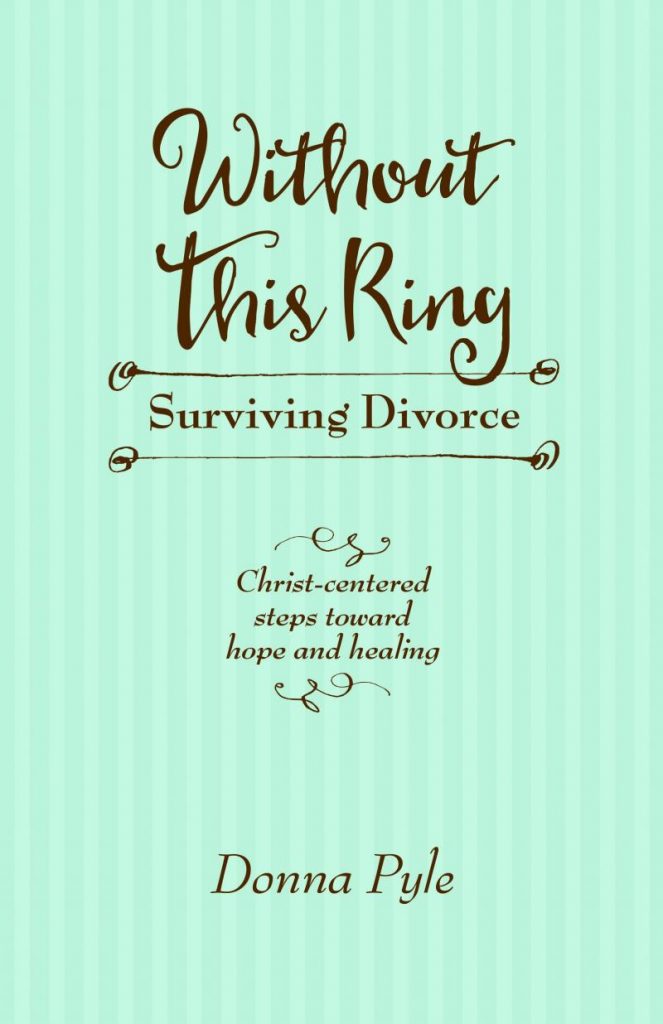
I have written an entire Bible study on Forgiveness that you can find here, as well as a book/Bible study on surviving the thriving after divorce here.
{As an Amazon Associate I may earn from qualifying purchases. Photos are obtained from Unsplash.com}
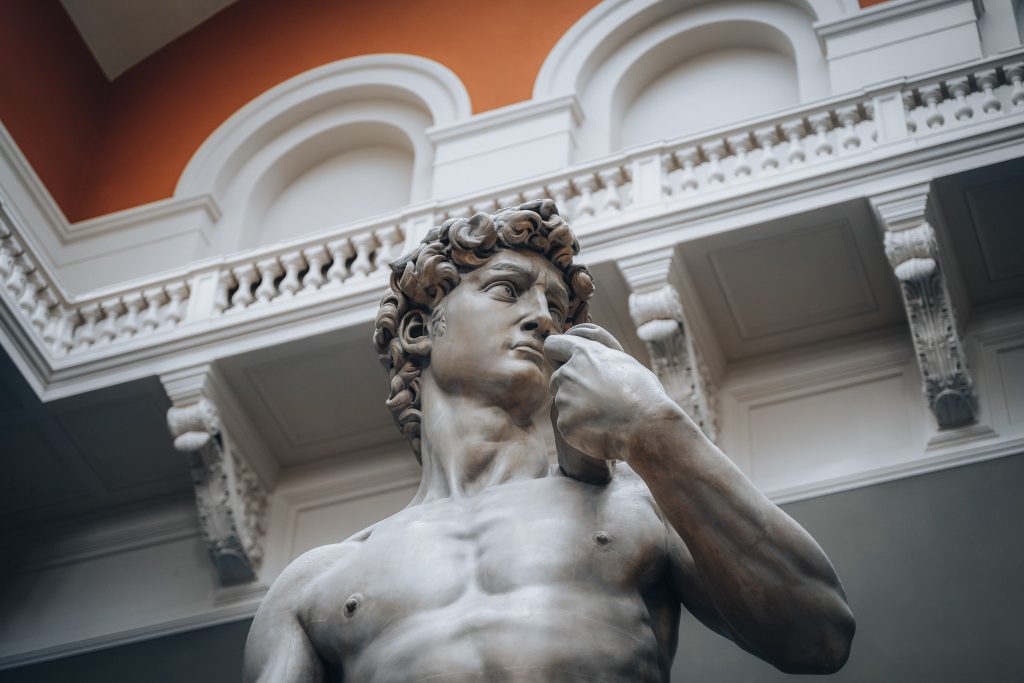
David vs. Goliath is one of the most iconic stories in the Old Testament. Our culture has latched onto this story to describe any time we root for an underdog. But the original story is much more dramatic considering the weapon used.
Goliath Steps Out
As the Philistines square off against Israel, Goliath steps out to engage the Israelites in a battle technique known as “representative combat.” Each side picks one man to represent their army and whichever man triumphs gains victory for the entire army. There is a lot at stake.
Goliath taunts Israel twice a day for forty days, but King Saul only cowers. Then a small shepherd boy shows up on a cheese run to bring refreshments to his brothers and check on them at the battlefront. David was like an old-school Uber Eats.
“As he talked with them, behold, the champion, the Philistine of Gath, Goliath by name, came up out of the ranks of the Philistines and spoke the same words as before. And David heard him” (1 Samuel 17:23).
David had probably never heard anyone curse God. I mean who would have the nerve? As David demands to know what will be done to the one who insulted God, Saul overhears the fuss and summons David.
And David said to Saul, “Let no man’s heart fail because of him. Your servant will go and fight with this Philistine. Your servant has struck down both lions and bears, and this uncircumcised Philistine shall be like one of them, for he has defied the armies of the living God” (1 Samuel 17:32, 36).
Saul knows the stakes are high. If he sends David into representative combat and David meets defeat, they all lose. And even though Saul is the tallest Israelite and looks most capable, God looks at the heart.
Saul finally agrees to send David to face Goliath. No armor is needed.
I wonder if Saul started dictating his last will and testament as soon as David stepped onto the battlefield. And can you imagine the Israelite army’s reaction to their representative? Wait…what?
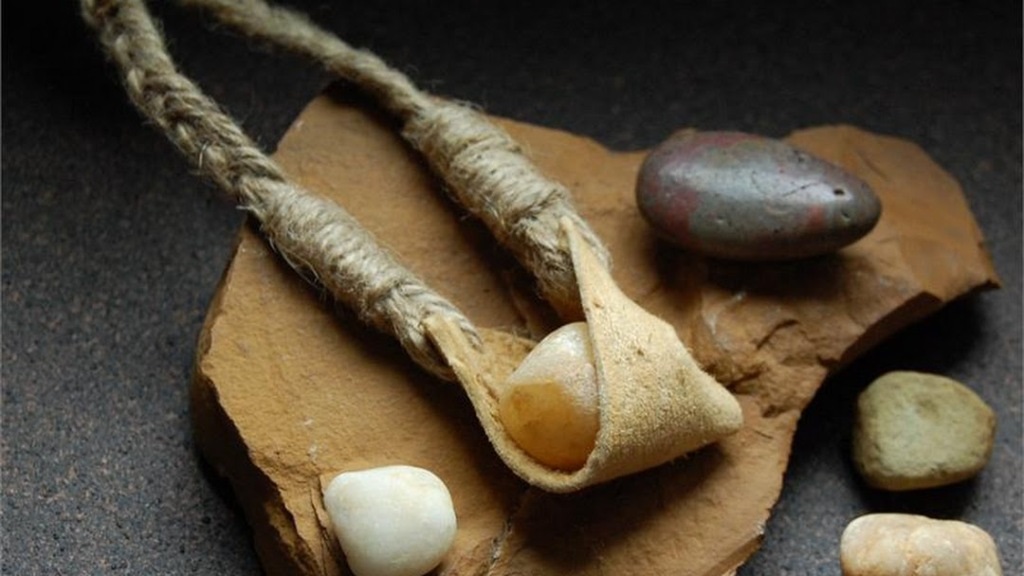
Years ago I watched a documentary describing weapons used in ancient times. The demonstration regarding the sling and stone was riveting. The scientists set up a watermelon on a pole to represent someone’s head.
Then they picked up a sling and stone similar to what David would have used. The stone would have been anywhere from a golf ball to a baseball in size.
The scientists placed the stone in the sling, backed away to a good distance, wound it up, and let it fly. The cameras clocked the stone at over 100 mph. The watermelon exploded on impact.
Goliath relied on his size. David relied on the size of his God.
The next time you face a battle of any kind, remember Scripture assures us that God has gifted you with special tools that the enemy severely underestimates. Love, compassion, forgiveness, and His mighty power within you provide the strength you need to be victorious.
The enemy may see you as a courier, not a warrior.
{Some of these links are affiliate links. This means if you make a purchase through that link, the ministry may receive a small commission at no extra cost to you. Thank you for your ministry support!}
My view of Jerusalem in 2010 as I walked across the Kidron Valley toward the East Gate.
After eighteen months of planning and preparation, my group and I leave for Israel on Wednesday!
Pastor Wayne Graumann and I will be teaching at various locations as our group of 35 pilgrims make our way through the Holy Land. Here are the dates and locations during our journey:
Wednesday, Nov. 13 – Depart the USA, arriving in Tel Aviv on Nov. 14th Thursday, Nov. 14 – Jaffa, Caesarea Friday, Nov. 15 – Megiddo, Mt. Carmel, Nazareth, Cana, Mount of Precipice Saturday, Nov. 16 – Mount of Beatitudes, Capernaum, boat ride on the Sea of Galilee, Bethsaida, Jordan River, Tabgha, Church of Primacy of St. Peter Sunday, Nov. 17 – Caesarea Philippi, Tel Dan, Gideon Springs, Beit Shean, Jerusalem Monday, Nov. 18 – Western Wall, Temple Mount, Via Dolorosa, Southern Steps, Bethlehem Tuesday, Nov. 19 – Qumran, Ein Gedi, Dead Sea (swim/float), Jericho Wednesday, Nov. 20 – City of David, Shrine of the Book, Model City, Hezekiah’s Tunnel, Pool of Siloam, St. Peter Gallicantu, Garden Tomb Thursday, Nov. 21 – Mount of Olives, Palm Sunday Road, Elah Valley and the Garden of Gethsemane Friday, Nov. 22 – Depart the Holy Land to return home forever changed
Wayne and I will both be blogging (with photos) each day along our journey and we would love for you to follow along. My posts will appear here and Wayne & Kathy’s posts will be here: https://gofarther.me/
We would covet your prayers as our group of 35 walks the very places where Jesus walked. The spiritual growth that each of us will experience simply cannot be overstated. We carry you in our hearts with us!
During a leisurely lunch with three dear friends some time ago, horror stories and scars surfaced around two familiar topics.
Among the four of us, two are married with children, one has never been married or had children, and one is divorced with no children. We range in age from 35-51 and are committed Christ followers.
First, I need you to know something. This post took significant time to write and pray through because it’s rather blunt about sensitive topics.
This post isn’t a vent — it’s a plea borne out of loving others. That being said…
Throughout our adult lives, my three friends and I have been asked two questions so many times that we’ve lost count. To this day, we remain flabbergasted that some women haven’t caught on. There are two questions that plainly shouldn’t be posed to another woman — unless she’s your BFF or a close second.
Question #1: Why aren’t you married?
Stated like that, this question isn’t really a question. It’s a judgment.
Since I didn’t get married until I was 29, I fielded that question a LOT of times. We met when I was 23, dated for two years and were engaged for four years while he finished post-graduate college. During those six years, if we would have collected $1 from each woman who asked me why I wasn’t married yet, we could’ve easily paid for the wedding and honeymoon four times over.
As our conversation continued, my three friends and I realized that more often than not this question was posed by married women. That’s tantamount to a millionaire asking an unemployed person why they aren’t buying a mansion.
Even if asked in a caring or flattering way (perhaps she thinks highly of you), it still stings. Believe it or not, some women ask it to intentionally inflict emotional or social harm. And trust me, those on the receiving end can tell the difference.
I’ve also been asked innumerable times since my divorce nearly ten years ago why I have not remarried, along with who, when and whether or not I am dating. Frankly, the answer is entirely too personal to discuss nonchalantly with casual acquaintances. So I never bother.
Last month, a Christian friend whom I hadn’t communicated with in a while asked about my dating status. When I responded that I was not seeking to be in a relationship, she typed a stunning one-word response: “Disobedient” — immediately followed by, “You’re not a nun.”
Wow. Currently, I am more content in Christ, peaceful and purpose-filled than at any other time in my adult life. But she didn’t ask about those things. She simply judged one aspect as the whole story and moved on.
If you are single, divorced or widowed, perhaps you need to hear this today: God gave marriage as a blessing, not an entitlement or commandment. He did not create us as half a person seeking another half to “complete” us. We are whole and complete in Christ alone. The rest is all grace.
I loved serving God as a married woman. I love serving God as a single woman. Simply put, God calls some women to serve through their marriage and others through undistracted singleness. The key is a passion to love and serve God no matter your marital status.
And the second question…
Question #2: Don’t you want children?
Again, stated like that, this isn’t a question. It’s a judgment.
This question has caused more scars in my life (and my three friends) than any other. It presupposes so many things that it’s hard to know where to begin addressing it.
Asking a single woman that question is cruel — whether intentional or not. Perhaps having children has been a lifelong, unfulfilled dream that has cost her many sleepless nights and a river of tears. What if she believes marriage should come first? Should she rush out to the nearest bar and hook up with the first man she sees? Should she rush to the sperm donor bank and sign up?
Asking a married woman that question presupposes that she is physically able to bear children. Perhaps she and her husband have tried to conceive children for years only to face financial hardships due to unsuccessful fertility treatments. No woman should ever be expected to share her private struggles or physical condition to justify why her home isn’t overflowing with children.
My ex-husband and I were married for thirteen years, but didn’t have children. We trusted God’s plan that if He wanted us to have children, He would provide. I believe we would have been wonderful parents. But now looking back on divorce, I believe God knew best.
Some people have pulled out the Christianity card. “God designed women to have children, so you’re disobeying if you don’t have them.” Yes, people have actually had the audacity to say such an unkind thing to me and my three friends in the past. And when such a statement comes from someone we hold dear, the wound plunges deep.
Some people have played the adoption card. “So many children need good homes, why aren’t you willing to adopt?” Stated like this, that question is also a judgment. Perhaps she is, in fact, willing to adopt, but is still thinking and praying through the many considerations of such a monumental commitment.
Simply put, no woman owes another an explanation to these two extremely personal questions. Over time, I’ve learned to smile and deflect the tension. However, the pain inflicted still takes significant prayer, extending relentless forgiveness, and time for God to heal.
The bottom line?Those two questions negate God’s sovereignty. They infer that we need to follow cultural norms or our own plans instead of submitting to His. If no one has ever asked you either question, you are among the blessed minority.
If you are unmarried or do not have children, please hear this truth loud and clear:
Despite your marital or parenting status, God loves you right now. Just as you are. Precisely where you are. You can joyfully, successfully serve him today.
Following God isn’t about conforming to some cultural mold of how others believe our lives should look. Remember the Apostle Paul? The Apostle Peter? One was married, one was not; one had children, one did not — but they made a powerful difference for God’s kingdom from their individual, God-designed circumstances.
God can use any person at any time in any place for His holy purposes.
No tangible thing on this earth makes us more or less of a Christian. Following Christ never hinges on whether or not we’re married or have children. It’s about being in relationship with Him. It’s about our desire to know Him and be fully known by Him. To rely on Him for our every need. To receive His immeasurable love and amazing grace into the deepest recesses of our soul with overwhelming gratitude.
So to my fellow women who have been on the receiving end of these two questions: I love you. I know what it feels like and I’m so sorry for your pain.
And to those women who believe it’s okay to keep asking another woman either of those questions, STOP.
PLEASE STOP.
They damage — and even kill — friendships.
*These wonderful friends are not members of my home church. They read this post when I originally wrote it and gave permission to share the generalities of our discussion in the hope of shedding much needed light on this sensitive topic.*
_________________________________
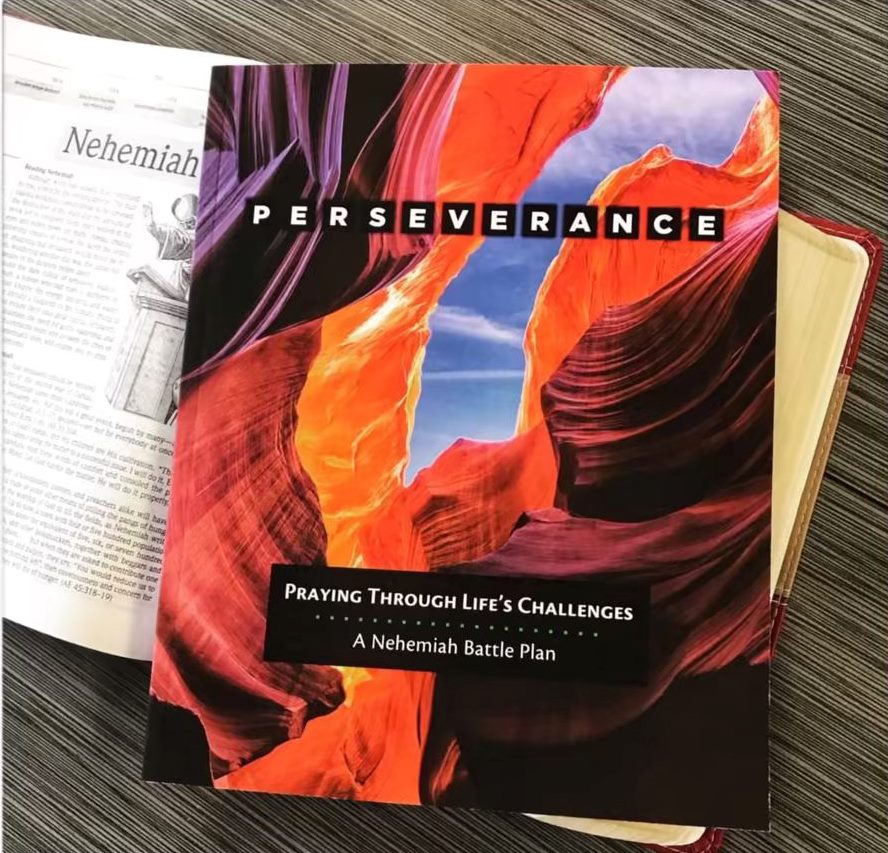
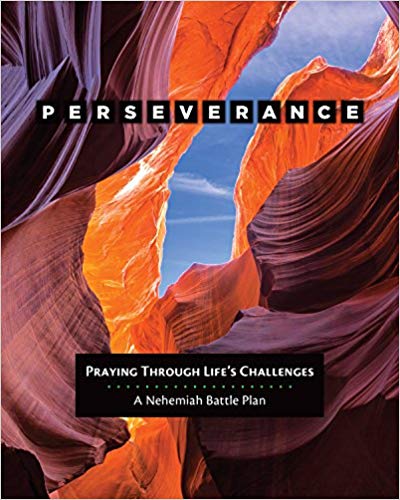
Donna’s brand new individual and small group Bible study: “Perseverance: Praying Through Life’s Challenges” (based on the book of Nehemiah) is now available through Concordia Publishing House and Amazon.
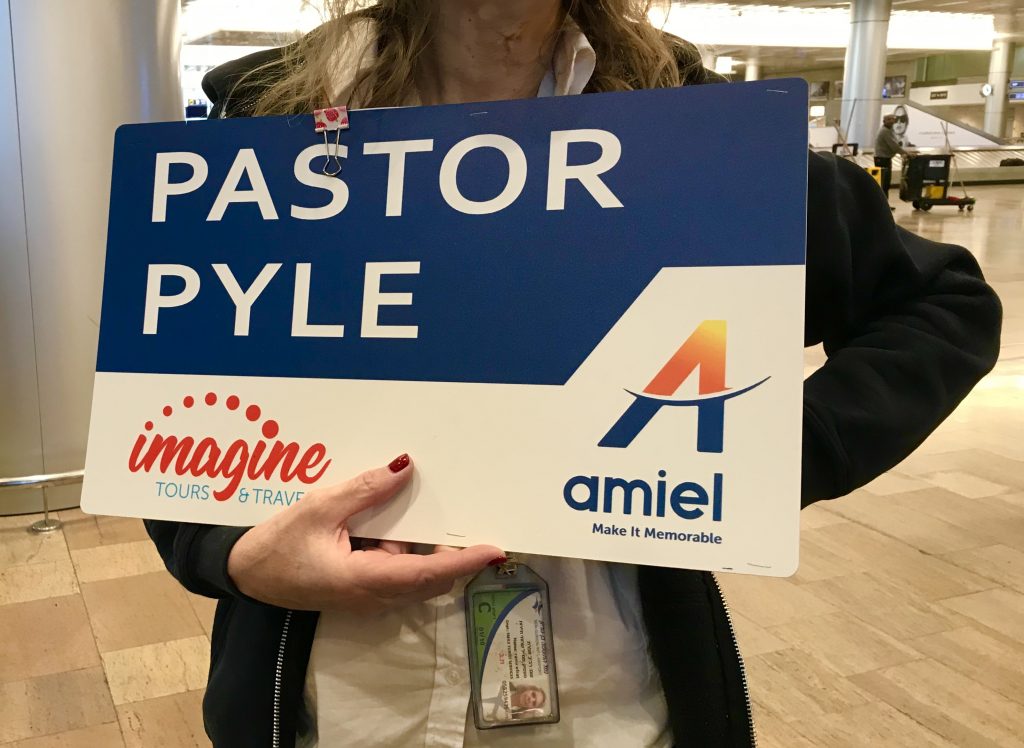
After nearly eighteen hours of travel, our group of 35 pilgrims arrived safely in the Holy Land. We were tired but exhilerated! Our Imagine Tours guide met us at the airport holding this greeting sign that provided us all a hearty chuckle to start our adventure.
I’m uncomfortable. 🙂
After climbing aboard our bus, we headed straight toward Jaffa – the modern name for the biblical city Joppa. The Hebrew word Joppa means beauty, which was evident by its breathtaking location overlooking the Mediterranean Sea.
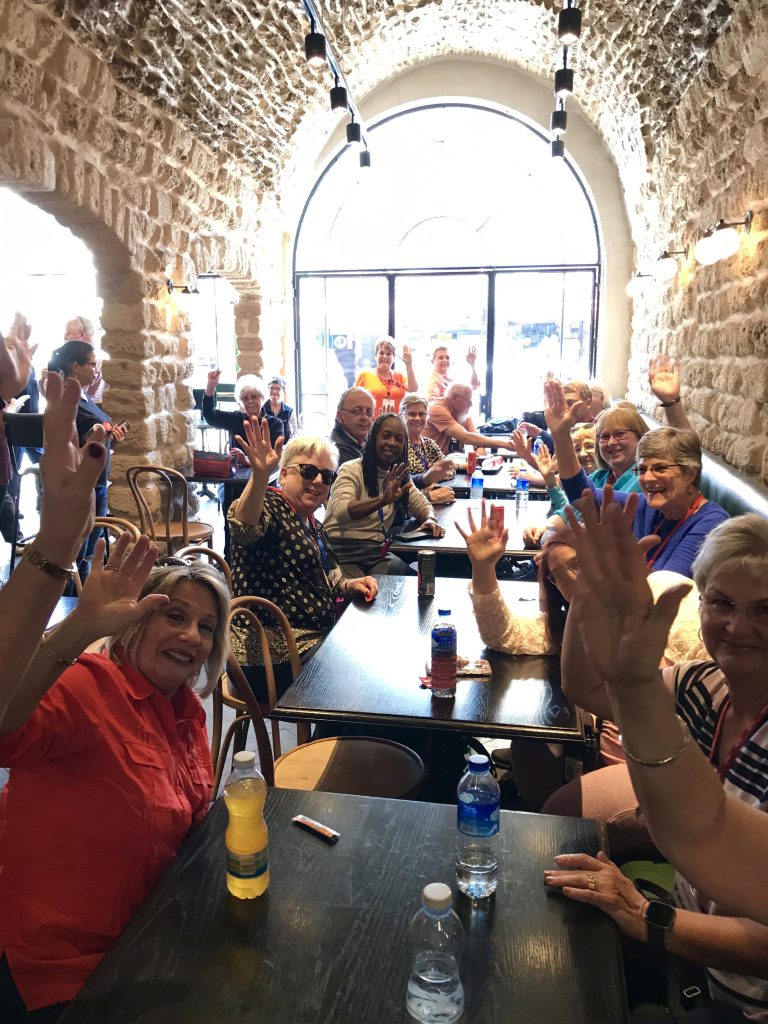
Our first order of business was to try out the local fare for lunch that included falafels and shawarma (meat cut into thin slices, stacked in a cone-like shape, and roasted on a slowly-turning vertical rotisserie).
Our first meal in the Holy Land!
We walked through Joppa seeing the seaport that Solomon used to import cedar logs from Lebanon which were used to build the original Temple of God in Jerusalem. It was from here that Jonah attempted to flee God’s calling to preach to the rebellious people in Nineveh.
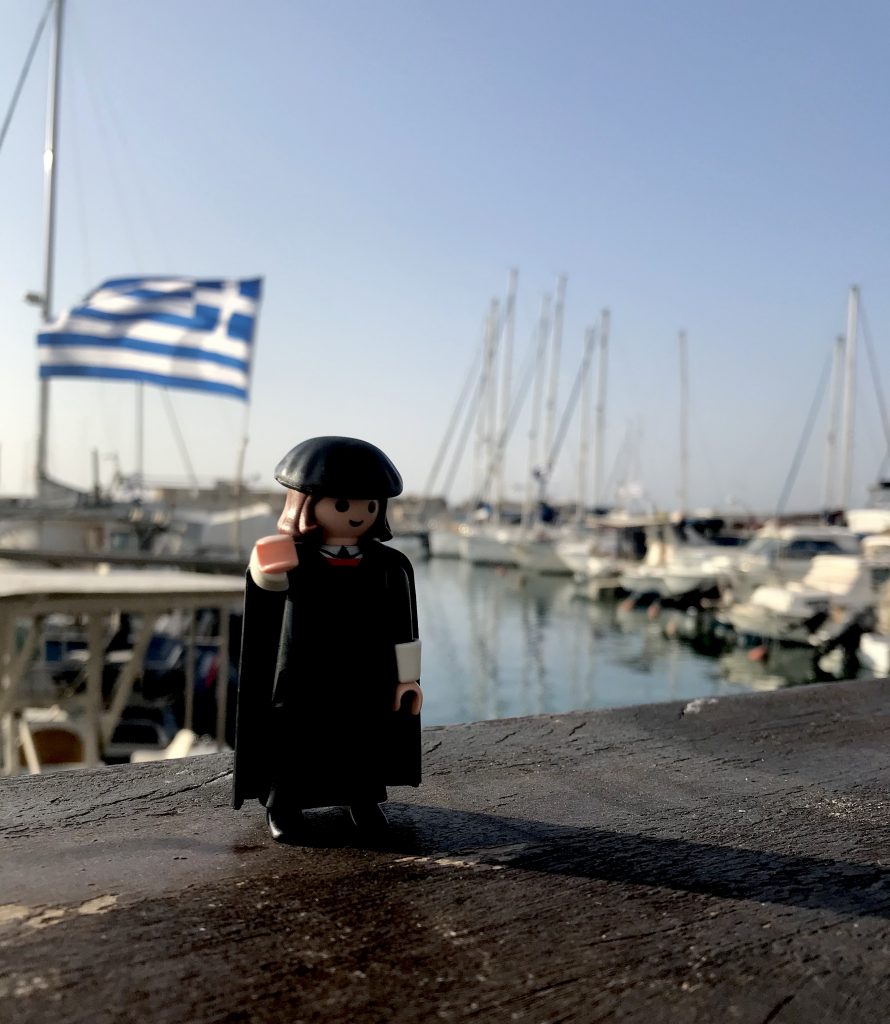
Little Luther waving from Jaffa
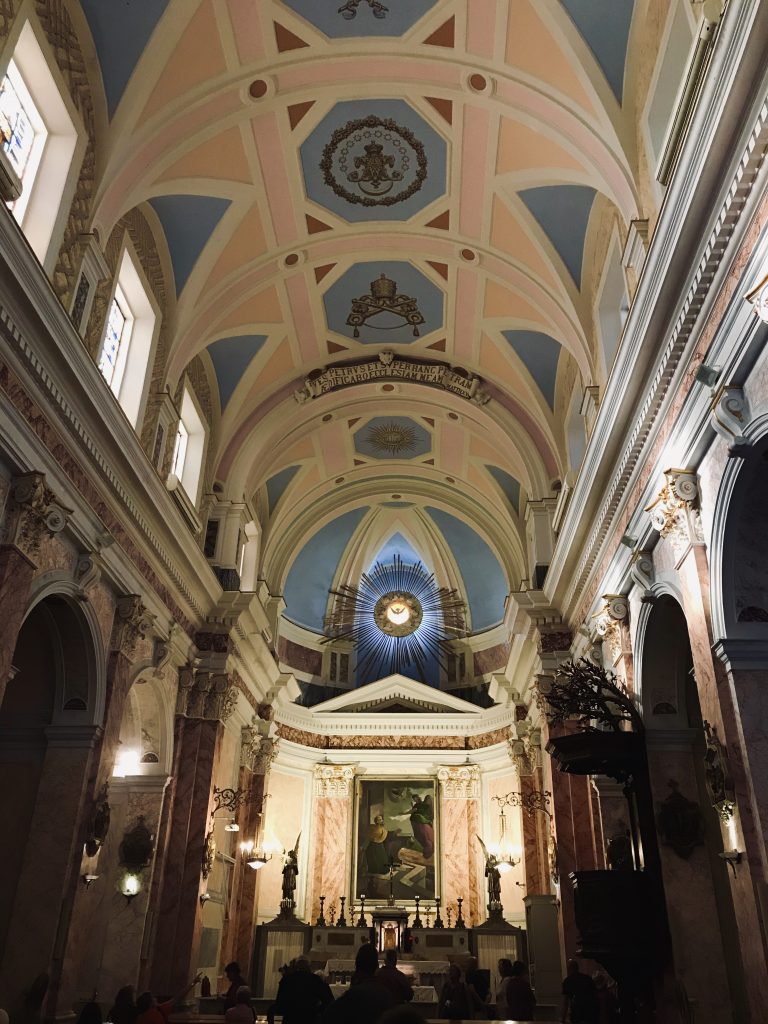
We wound our way through narrow stone streets and walkways to spend some quiet time in the Church of St. Peter, which is believed to have been built over the site of Simon the Tanner’s home where Peter received the missionary vision from God in Acts 9-10.
St. Peter’s Church in Jaffa, Israel
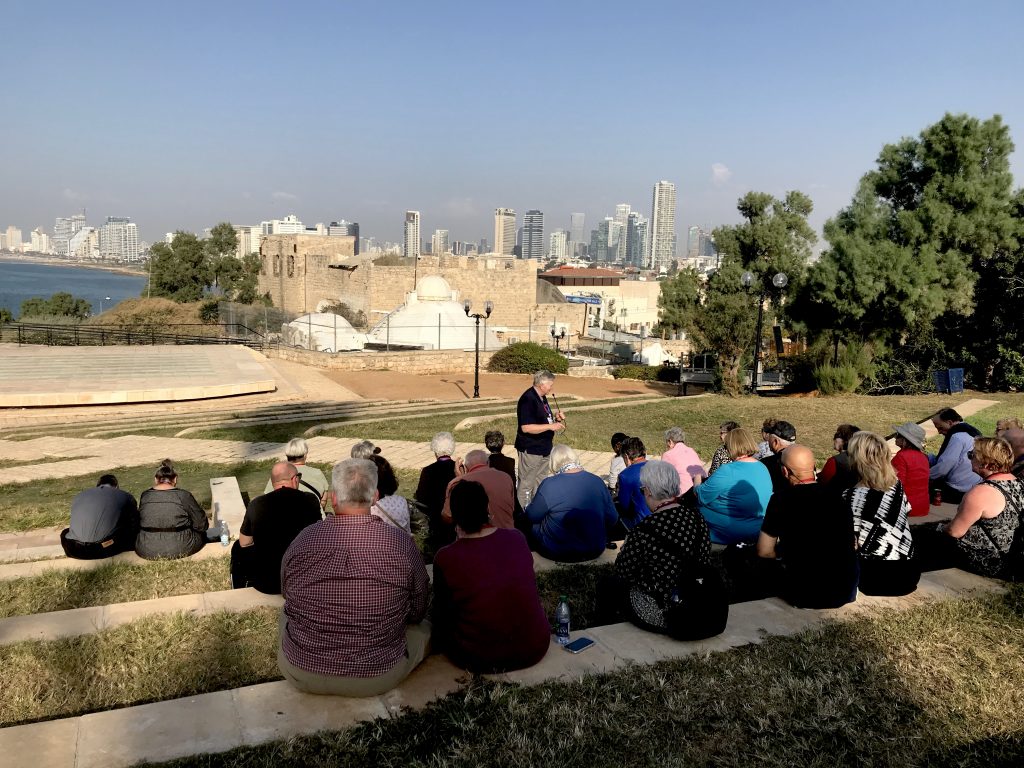
Wayne gathered us for a time of prayer overlooking the city to pause our busy feet and minds to ask God to bless our time for this great spiritual adventure.
Wayne gathering us for prayer overlooking Jaffa, Israel
We concluded our day with a delicious meal of local fare of grilled fish, a plethora of fresh vegetables, and mini lamb burgers at our hotel in Netanya, Israel. Even though we were in the middle of a bustling city that is home to nearly a quarter million people, the sea breeze and beautiful shorelines of the Mediterranean Sea beckoned within walking distance.
Thank you, God, for getting us here safely an starting off our adventure in such stunning surroundings!
“The harvest is plentiful but the laborers are few. Therefore pray earnestly to the Lord of the harvest to send out laborers into His harvest.” Luke 10:2-3
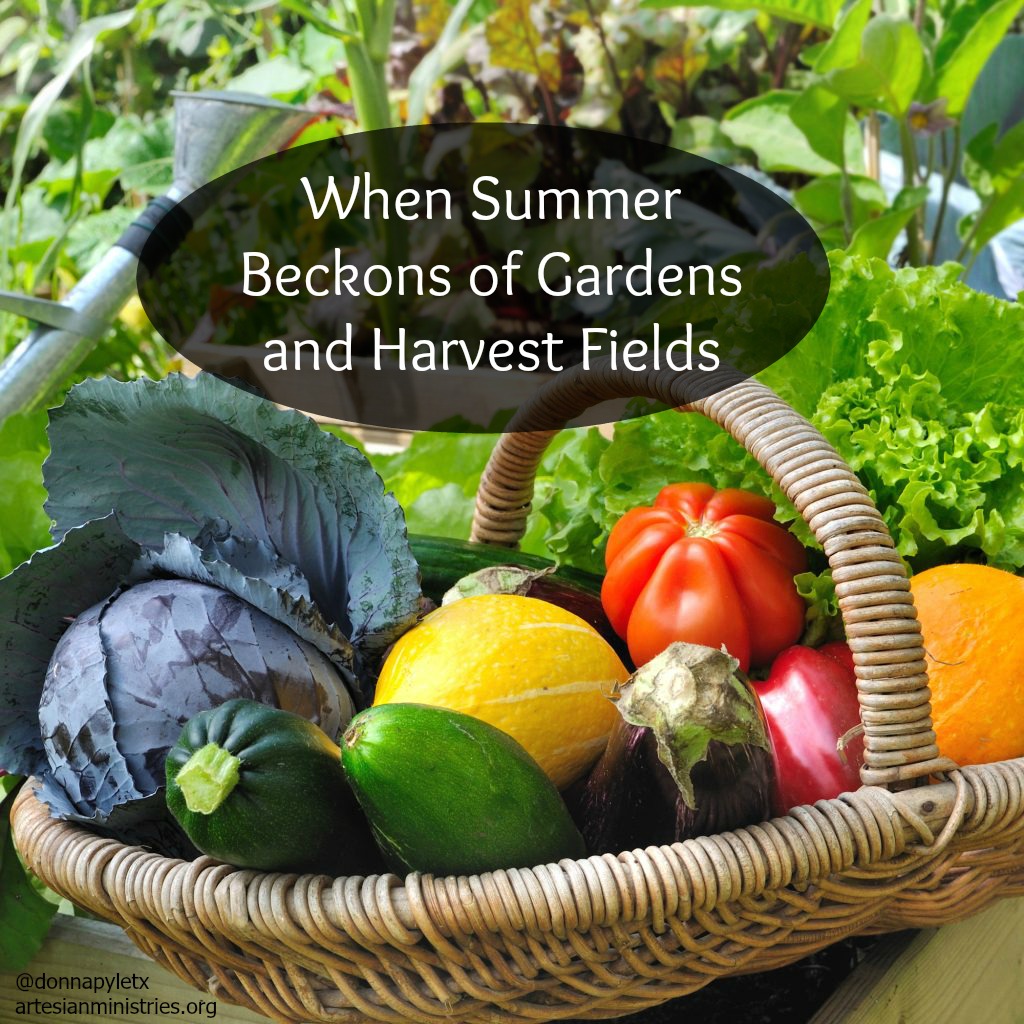
As a little girl, Grandma’s garden was a magical place. Rising early, I would open the low picket gate, hands trembling with anticipation. After all, high adventure awaited.
I loved pretending that beautiful oasis was my kingdom. I ruled over butterflies, bumble bees and fat red earthworms. My scepter was a fragrant stalk of mint and my princess glitter was the fresh morning dew.
Grandma puttered around in her floppy hat, earth-encrusted gloves and apron patiently weeding, pruning and keeping the kingdom delightful. She taught by example how loving care encourages gardens to produce a rich harvest.
By the end of our lazy, garden mornings together , her small basket overflowed with tomatoes, cucumbers, onions and other fresh delights we would enjoy later in the day.
Flowers were my crown, a little summer dress was my ball gown, and life couldn’t get any better all the way around.
Although picturesque, when Jesus said that the harvest is plentiful, He meant something entirely different than my childhood kingdom.
Jesus spoke of souls, not of garden knolls. Instead of butterflies, bees and worms, He spoke of laborers bringing in His harvest.
That’s you. And that’s me. Every Christian who calls themselves a disciple is His laborer.
Harvest denotes a time of urgency, not lazy summer days. It offers a precious short window of opportunity to pluck what the Lord of the harvest has already prepared: souls for His kingdom.
As His laborers, do we adopt the same sense of urgency? With over seven billion people on the planet, the harvest field is massive. When Jesus spoke these words about the harvest field, He looked upon a generation open and ready to receive the Gospel.
You and I live in a generation ready for harvest.
Look around, what do you see? I see thousands coming together at youth gatherings and Christian conferences. People say the church is declining. I say we’ve lost focus on the harvest.
Instead, what if:
…we focused on reaching the lost instead of counting heads in the pew?
…we focused on ministry initiatives instead of placating the comfortably saved?
…we focused on mobilizing God’s laborers into the harvest field instead of moving someone out of the White House?
Being His laborer means I need to stop acting hypocritical and start loving people like Jesus did. It means being willing to risk it all and get my hands dirty to bring in His harvest.
It’s HIS harvest. You and I just have the privilege of being His gardeners, our wages fully paid by His sacrificial blood at Calvary.
It’s a great big world. We have a great big job. And we have a great big God who has equipped us to bring in His holy harvest.
So we believe.
We pray to the Lord of the harvest and step out in faith, trusting Him to bring in an overflowing abundance.
We can even wear a floppy hat.
_____________________________________________
Donna’s brand new Bible study: “Perseverance: Praying Through Life’s Challenges” (based on the book of Nehemiah) is now available through Concordia Publishing House and Amazon.
“And Joseph also went up from Galilee, from the town of Nazareth, to Judea, to the city of David, which is called Bethlehem, because he was of the house and lineage of David, to be registered with Mary, his betrothed, who was with child.” (Luke 2:4-5)
“Can anything good come out of Nazareth?”
That’s what Nathanael asked Philip in John 1:46 when Philip announced that they had found the One about whom Moses and the prophets wrote.
Rather than take offense at Nathanael’s skeptical question, Philip simply invited Nathanael, “Come and see.” Moments before, Jesus had invited Philip to follow Him. Now Philip invited Nathanael to see Jesus with his own eyes.
It comes down to inviting.
In the heart of today’s bustling City of Nazareth, the Church of Annunciation sits over the site believed to be Mary’s house. Originally built in the mid-4th century by Constantine, the church invites visitors to see the place where the angel Gabriel announced to Mary that God had chosen her to be the mother of the Messiah.
In Nazareth, Mary received a holy invitation to be a key player in an epic story that re-wrote history.
Christmas and invitations go hand in hand. God invites us to receive by faith the most priceless Gift ever given. You and I invite others to see the hope of the world reflected in the holy eyes of a Baby.
And then there was Bethlehem.
The word “Bethlehem” likely brings to mind nocturnal shepherds watching over their flocks. However, its meaning extends far beyond a pin on a map.
The word Bethlehem comes from two Hebrew words: (1) beth and (2) laham. Beth, roughly translated, means house. It does not necessarily denote a specific kind of building, but rather its function. Laham is a masculine noun which means bread (Genesis 18:5; Numbers 21:5). In fact, Leviticus 21:6 refers to laham as sacrificial bread.
So what is the significance? Bethlehem means House of Bread. What is a house of bread? A bakery. How did Jesus self-identify in John 6:35? “I am the bread of life.”
Some may scoff and dismiss it as a cutesy coincidence that God introduced the Bread of Life to the world from a bakery. But wait. What is a bakery’s function? To provide food. Time and again Jesus fed the multitudes, both physically and spiritually. And the Word made flesh continues to feed us through Word and Sacrament today.
Advent is a time for us to praise God for the gift of the Bread of Life, who taught, “Man shall not live on bread alone, but on every word that comes from the mouth of God” (Matthew 4:4).
Then there was Mary.
Mary’s betrothal time should have been filled with happy preparation for her new life as Joseph’s wife. Instead she grappled with the staggering news that she was pregnant. Not because their passion raged out of control, but pregnant like no other woman before or since ─ by the Holy Spirit.
A virgin conception? Incredulous at best, blasphemous at worst.
Yet Mary believed God’s angelic messenger. She trusted by faith and set the holy standard for surrender and submission: “I am the servant of the Lord; let it be to me according to your word” (Luke 1:38).
Even though people could legally stone her to death? Let it be.
Even though Joseph could divorce her? Let it be.
By God’s amazing grace, Mary’s womb carried the One who conquered our tomb. Let it be!
And finally there was Joseph.
Chosen by God among all men on earth to be the guardian of our Lord. In steadfast faith, Joseph believed God’s message in a dream. Unwavering, he stood by Mary when culture dictated that he shun her.
With relentless perseverance, Joseph traversed miles on foot to become a midwife on the fly. He followed Caesar Augustus’ census decree and registered with the lineage of David — from which would birth the Divine.
Joseph adopted the Father’s Son and safeguarded the Light of the world.
Mary and Joseph were handpicked by God to nurture the Cherished of God. They didn’t ask for it. They likely faced persecution over it. They could have given in to fear and trembling, yet God strengthens those who turn to Him in faith.
Even though God’s plan turned their quiet life chaotic, Mary bowed low to lift His praise high: “My soul magnifies the Lord, and my spirit rejoices in God my Savior.”
So, can anything good come out of Nazareth?
“Behold, the Lamb of God, who takes away the sin of the world!” (John 1:29)
Coming in 2019:
New 8-week DVD Bible study series based on the book of Nehemiah
(Published through Concordia Publishing House)