
Dear Pastor’s Wife: Please Forgive Us

A little over two weeks ago, I wrote a blog post dedicated to pastors.

The response was incredible.

Beyond the blog and Facebook comments seen by all, what touched me the most were the responses that came through phone calls, texts, private Facebook messages, and even notes through the regular mail from those who love our pastors most: their wives.

They expressed such gratitude at the encouraging words shared on the post for their husbands. 

It reminded me about the challenging road our pastors’ wives walk — not only my pastors’ wives but the plethora of these amazing women whom I have had the privilege to meet and befriend all over the country.

So to each of you precious, dearly-loved, women of courageous faith:

You gracefully stand silently in the shadows while people clamor for your husband’s attention and heap praises on him (though he deserves it) when we choose not to notice you.

Please forgive us.

You live in a glass house where everything is scrutinized, yet you continue to keep those windows clean with the forgiveness extended that we often don’t deserve.

Please forgive us.

We ruthlessly police your fashion, hairstyle, hair color, size, and words like it’s our sole duty on this planet.

Please forgive us.

You sit dutifully while your husband uses your family as a sermon illustration pun again and smile while we laugh at you.

Please forgive us.

When we gripe, complain or criticize something about your husband or the church — even when it gets so nasty that there should be a smack down right in the middle of the narthex — you smile graciously and tell us that you will pass along our concerns.

Please forgive us.

You strive to walk as a disciple of Jesus, faced with the same struggles and complications that we go through, yet you’re faced with the challenge of going through many things silently.

Please forgive us. 

You are often thrown into positions in the church that no one else wants to do — often areas you are not gifted in — yet you trudge faithfully ahead while we criticize every step.

Please forgive us.

And then, there’s this:

Some days, you worry the stress may kill your husband. You desperately want to be in the will of God but may be afraid of what that might require of you, your marriage and your children.

You long to help the multitudes and would lay down your very lives for the beautiful body of Christ, and that makes you very, very tired. Perhaps you wonder when your husband retires if you will ever walk into a Church again. Sometimes sheep bite.

But I want you to know, dear Pastor’s Wife: 

It’s tough and can get lonely out there, but you are standing on the Rock.

You may not have anticipated this calling to be a pastor’s wife, but God has equipped you for this noble work.

God will faithfully provide helpers to you who love you wholeheartedly and find joy in praying for you and walking alongside you — whether inside or outside your Church.

Jesus can heal your wounded soul, renew your tormented mind, reconcile broken relationships, bring about forgiveness, bring hope in the midst of exhaustion, mend your broken heart, and meet your every need.

I pray for God to keep faith and hope alive in you, because WE NEED YOU.

We may not always tell you, but please know this:

You are LOVED.
You are BEAUTIFUL.
You are VALUED.
You shine God’s light RADIANTLY.

Sisters, I love you dearly and esteem you greatly. THANK YOU for your extraordinary sacrifice of praise to Christ our Savior.

Church, when was the last time you prayed for your pastor’s wife?

C’mon, let’s encourage them today. What say you?
Save

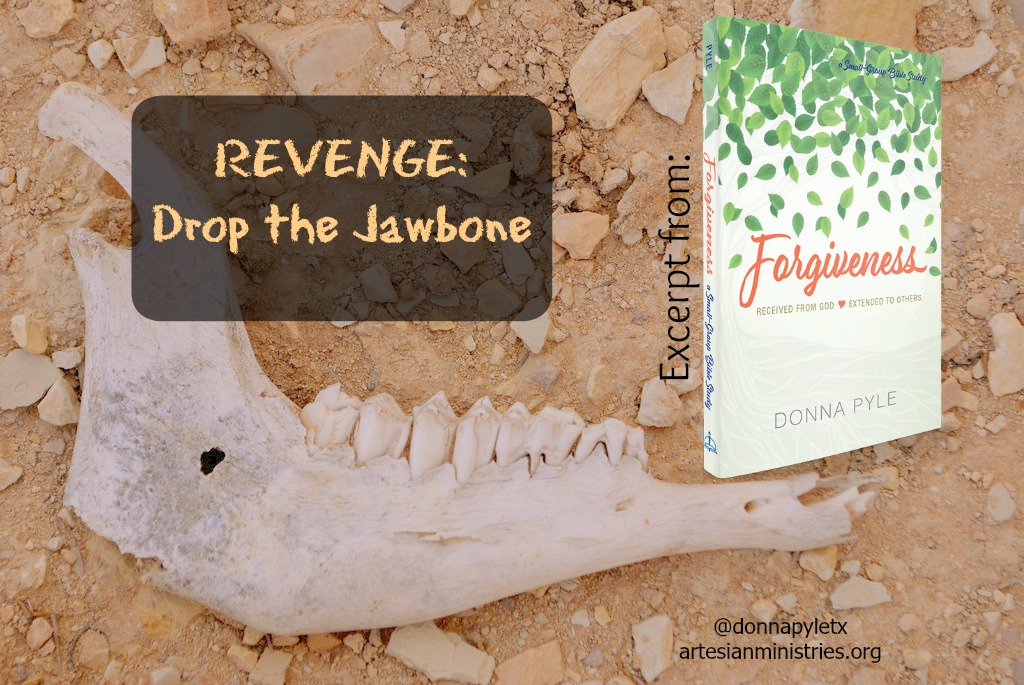
Revenge: Drop the Jawbone

Samson had an anger problem. Well, maybe he just never learned how to process anger well.

In Judges 15, an incident between Samson and his father-in-law eventually escalated into battles involving nations and the slaughter of thousands of innocent people.

All because of revenge.

When Samson returned home to his wife after a time away, he learned that his father-in-law (thinking Samson hated his wife) gave her to Samson’s companion. To add insult to injury, his father-in-law then offered his other daughter to Samson.

In a rage, Samson declared war on the Philistines (his father-in-law’s people) by torching their grain fields and olive orchards (Judges 15:1-5). The destruction affected the Philistines both economically and religiously, because they believed in gods of harvest, among others. In retaliatory revenge, the Philistines burned Samson’s wife and father-in-law to death (Judges 15:6). Ironic.

Samson vowed not to stop his rampage until he exacted revenge for his wife and father-in-law. He subsequently attacked and slaughtered many Philistines (Judges 15:7–8).

The Philistines retaliated by hunting down Samson, attacking the town of Lehi on the way. Three thousand men of Judah confronted the Philistines to ask why they were coming against them. When the Philistines named Samson as the culprit, the men of Judah found Samson and handed him over (Judges 15:9–13).

But Samson wasn’t finished. He picked up the jawbone of a donkey and killed one thousand men with it. One thousand men. All of this destruction and mayhem started with Samson, his father-in-law, and a goat.

Why are we so bent toward revenge? What is it that makes revenge alluring?

When it comes to revenge there are two basic types:

Active revenge: This kind of revenge moves aggressively toward our offenders. Perhaps a family member says something derogatory about your spouse. You immediately take offense and start telling the rest of the family about their many faults (whether secret or not). Active revenge always hurts far more people than we realize.

Passive revenge: This kind of revenge deceptively looks like forgiveness. Passive revenge does not move aggressively toward the offender, but takes the form of withholding, cold shoulders, or secretly celebrating when something negative happens to them. It is forgiveness lip service, not a genuine movement toward it.

Revenge tells God, “You’re in my seat.” When I choose to take revenge, I alone determine the severity of a person’s transgression, the proper method of punishment, and the time frame in which it needs to occur. Revenge inflates the ego because I alone determine that God is not moving fast enough or meting out what I believe is appropriate judgment. Consequently, I take matters into my own hands and execute judgment. Revenge means failing to entrust my wound to God’s justice.

Revenge always escalates. An offense can start with something as small as the rolling of eyes at someone’s behavior in a social setting. But it doesn’t end with reciprocated rolling eyes. It always escalates. Remember Shakespeare’s Romeo and Juliet? The feud between the Capulets and the Montagues was “bred on an airy [misspoken] word.” Multiple civil brawls later, Romeo and Juliet died in their efforts to be together.

Revenge always inflames and creates an inflated ego that says, “I have the right to pay back the hurt they inflicted on me.” And back and forth it goes.

Forgiveness begins when you drop the jawbone.

When you find yourself in a situation where there is a nonstop back and forth, decide to put down the jawbone of revenge and back away. Forgiveness starts by refusing to participate in the game and stepping forward to end it.

Maybe we need to ask ourselves how much revenge is enough until we feel better? until our anger subsides?

The anger we feel from pain makes revenge seem logical. But anger can escalate quickly into rage and even hatred. Anger is an impossible blockade on the road toward forgiveness. That blockade can be removed only when we surrender the underlying pain to God for healing.

God takes our pain on Himself, so use God as the lightning rod for your anger. The psalmists did exactly that in Psalms 7; 10; 17; and 28. God alone is our avenger. Remember Job? There are dozens of places in the book where Job unloads his anger, frustration, and wounds onto God, along with a little sarcasm (Job 10:3). God can take all of those emotions and knows best how to handle them.

When someone wrongs us, instead of groping for a verbal weapon, reach for the Word of God: “praying at all times in the Spirit, with all prayer and supplication. To that end, keep alert with all perseverance” (Ephesians 6:18).

Instead of hitting our enemy, we can hit our knees. We can pray earnestly for God to heal our pain, remove our anger, and work forgiveness in us so we can extend it wholeheartedly to those who hurt us.

Instead of feeding our hurt, we can feed our heart. Relentlessly confess, repent, lay your hurt at His Table, and receive His forgiveness that refreshes.

God alone is our righter of wrongs. The power or responsibility does not lie with us (Romans 12:19).

Forgiveness relinquishes all rights to punish our wounders and give them over to Christ. God is a God of justice as much as a God of love. Forgiveness does not mean that our wounders get off the hook; it recognizes that we are not the righteous judge of sin. That authority belongs to Christ alone.

Follow Jesus, not the path of revenge.

Drop the jawbone.

It stinks to high heaven.

Literally.

**The winner of the Forgiveness book release giveaway is CAROL ALBERTS!  I’ll reach out to you today, Carol. Congratulations and God’s blessings! **

Save

Save

Save

Save

Save

Save

Save