
Queen Esther stands as one of the most courageous and influential young women in biblical history. But how did Queen Esther die?

Her story, preserved in the Book of Esther in the Hebrew Bible and Christian Old Testament, recounts how a young Jewish woman rose to become queen of Persia and saved her people from genocide.
Table of Contents
While the biblical text provides detailed accounts of her heroic actions, many wonder what ultimately happened to Queen Esther and how she died. So let’s explores both the biblical narrative and historical sources to shed light on the life, legacy, and death of this remarkable queen.
Who Was Queen Esther?
Esther, originally named Hadassah, was a Jewish orphan raised by her cousin Mordecai in the Persian capital of Susa during the reign of King Ahasuerus. This Persian king, identified by most scholars as King Xerxes I, ruled from 486 to 465 BCE. The Book of Esther describes her as beautiful in form and appearance, qualities that would eventually lead to her selection as queen.
The biblical account explains that King Ahasuerus, being full of the royal wine, deposed Queen Vashti for refusing to display herself before his guests during a great banquet. Such public rejection did not sit well with the king of Persia. At his wise men’s suggestion, he ordered a search throughout his kingdom for a new queen.
Related: Chosen: A Study of Esther

The Miss Persia Contest
Beautiful young virgins were brought to the king’s palace, and young Esther was among them. She found favor with Hegai, the custodian of the women. After twelve months of beauty treatments overseen by the king’s eunuch, it was Esther’s turn to be presented to the king.
One night with the king changed this young woman’s life forever. Ahasuerus loved Esther more than all the other women. Consequently, the king’s edict turned Esther’s role into queen in Vashti’s place. Placing the royal crown on her head meant that Esther’s life in the royal palace began.
Esther’s Hidden Identity
Before Esther was swept into the king’s palace, her older cousin Mordecai instructed her to conceal her Jewish identity and heritage. This hidden identity would become pivotal to the biblical story‘s dramatic turn of events and ironic reversals. Living in the Persian court while secretly being part of a minority religious group required tremendous courage and discretion.
We can only speculate, but had the other beautiful young women who were in the running for queen ever discovered Esther’s Jewish heritage, they likely would have exposed it to take her out of the running. The fate of those not chosen was to be relegated to the king’s harem for the rest of their lives. Once the king touched them, no other man could.
Related: Queen Esther in the Old Testament
The Crisis That Defined Queen Esther’s Legacy
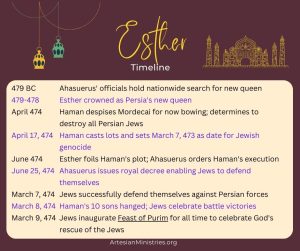
The central drama of Esther’s story in the citadel of Susa would not be complete without one of the main characters being a villain. So the official Haman slithers in from stage left. He is the perfectly evil villain in the form of a high-ranking official. King Ahasuerus promoted this wicked Haman above all other nobles.
Esther’s older cousin Mordecai, son of Jair, was a Jewish man. Despite historical evidence that Mordecai was a court official in the time of Xerxes, he was a man who understood God’s purpose.
When Mordecai refused to bow down to Haman based on his godly convictions, Haman became enraged. Rather than simply targeting Mordecai, Haman’s fury expanded to encompass all Jewish people throughout the Persian Empire.
Haman’s Genocidal Plot
Haman manipulated King Ahasuerus into issuing a decree that on the thirteenth day of the twelfth month of Adar. It declared that all Jews throughout the kingdom would be killed and their property plundered. Haman cast lots, or “pur” in Persian, to determine the most auspicious single day for this massacre. The royal decree was written, sealed with the king’s signet ring, and sent throughout the empire.
“Letters were sent by couriers to all the king’s provinces with instruction to destroy, to kill, and to annihilate all Jews, young and old, women and children, in one day, the thirteenth day of the twelfth month, which is the month of Adar, and to plunder their goods” (Esther 3:13).
While this decree caused Susa to be thrown into confusion, what did Haman and the king do? “And the king and Haman sat down to drink, but the city of Susa was thrown into confusion” (Esther 3:15).
That’s pretty cold-hearted to sit and clink glasses after the announcement of mass murder. Haman’s plot seemed to be working. Yet God’s plan was bigger.
Related: Who Was the Strongest Man in the Bible and Why?
Esther’s Dangerous Decision
When Mordecai learned of the decree, he sent word to Esther, urging her to approach the king and plead for her people. This request placed Esther in mortal danger. Persian law forbade anyone from approaching the king unsummoned under penalty of death.
“All the king’s servants and the people of the king’s provinces know that if any man or woman goes to the king inside the inner court without being called, there is but one law—to be put to death, except the one to whom the king holds out the golden scepter so that he may live. But as for me, I have not been called to come in to the king these thirty days” (Esther 4:11).
After initially expressing her fears, Esther’s response reveals her character and faith. She accepted the challenge with the famous words: “Go, gather all the Jews to be found in Susa, and hold a fast on my behalf, and do not eat or drink for three days, night or day. I and my young women will also fast as you do. Then I will go to the king, though it is against the law, and if I perish, I perish” (Esther 4:16).
This collective fasting represented both spiritual preparation and communal solidarity. It’s a beautiful reflection of godly behavior and trust in God’s plan.
Related: Fasting in the Bible: A Powerful Scripture Guide

Esther’s Strategic Approach
Rather than immediately revealing the plot, Esther demonstrated remarkable wisdom and strategic thinking. She fully dressed in her royal queen apparel and approached the king. He extended his scepter and offered to grant her request up to half his kingdom. Instead of making her petition immediately, she invited the king and Haman to a private banquet. At this first banquet, she invited them to a second banquet the following day.
“And when the king saw Queen Esther standing in the court, she won favor in his sight, and he held out to Esther the golden scepter that was in his hand. Then Esther approached and touched the tip of the scepter. And the king said to her, ‘What is it, Queen Esther? What is your request? It shall be given you, even to the half of my kingdom.’ And Esther said, ‘If it please the king, let the king and Haman come today to a feast that I have prepared for the king'” (Esther 5:2-4).
This strategy built suspense and allowed her to prepare her case carefully. Including Haman in the invitation elevated Haman’s pride before his fall, and gave God time to orchestrate events in her favor.
Two Banquets Make the Difference
During the night between the two banquets, the king could not sleep and ordered the royal chronicles to be read to him. He discovered that Mordecai had once uncovered and reported an assassination plot against him but had never been rewarded.
At the second banquet, Esther finally revealed both her Jewish identity and Haman’s genocidal plot. The king’s fury led to Haman being hanged on the very gallows he had prepared for Mordecai. Persian law prevented the king from revoking the original decree, so he issued a new decree allowing the Jews to defend themselves. On the appointed day, the Jews triumphed without any loss of life.
Related: The Valley of Dry Bones: Complete Biblical Meaning

Jewish Festival of Purim
The overarching theme of the Book of Esther is God’s deliverance of His people from destruction. The result is a wonderful celebration known as the Feast of Purim. This feast is not mentioned in Leviticus or anywhere else in Mosaic Law. However, were it not for the Book of Esther, we would not know how today’s Purim celebrations came about.
The Feast of Purim was established to commemorate God’s deliverance of His chosen people through the courageous bravery of Esther and her cousin Mordecai. Although only mentioned in the Book of Esther in Scripture, Purim has been faithfully celebrated by the Jewish people from the time of Esther until today.
Today, Purim is a carnival-type atmosphere where festival-goers dress up as characters from the book. An important part of Purim is the traditional of charitable giving of food and drink to the poor. Purim is one of the only two festivals designated apart from Mosaic Law that is still celebrated by Jewish people today. The other one is the Festival of Lights (Hanukkah) found in John 10:22.
Related: What Does Hanukkah Mean According to the Bible?
What the Bible Tells Us About Esther’s Later Life
The Book of Esther concludes with the establishment of the festival of Purim to commemorate the Jews’ deliverance. Mordecai became second in rank to King Ahasuerus among the royal officials, taking the place of Haman. However, the biblical text provides limited information about what happened to Queen Esther after these dramatic events.
The story of Esther in the Bible ends at the end of the book of Esther. Therefore, the best place to seek additional information comes from extrabiblical resources, historical facts, and archaeological writings during the time period in which she lived.
Esther’s Continued Influence
The final chapters of the Book of Esther indicate that Esther continued to exercise influence in the Persian court. Esther 9:29-32 describes how “Queen Esther, daughter of Abihail, along with Mordecai the Jew, wrote with full authority to confirm this second letter concerning Purim.”
This suggests she maintained her position and authority as queen and worked alongside Mordecai to ensure the proper observance of Purim among future generations.
The text also mentions that Mordecai’s acts and his might were written in the chronicles of the kings of Media and Persia, indicating that both he and presumably Esther remained influential figures in the Persian government for some time.
Unfortunately, those chronicles mentioned in Esther have never been found nor recovered. Imagine the wealth of insights, information, and wonders we would know if they are one day uncovered!
Related: Powerful Bible Verses for Self-Esteem and Self-Worth

Historical Sources on Esther’s Death
The canonical Book of Esther does not record how or when Queen Esther died. Various Jewish traditions and historical sources provide additional perspectives, though these should be understood as traditional rather than definitively historical accounts.
Jewish Rabbinic Traditions
The Talmud and other rabbinic literature offer some traditions about Esther’s later life. Some rabbinic sources suggest that Esther lived a long life and remained queen for many years. The Talmud includes discussions about Esther among the prophets and righteous women of Israel, indicating her enduring importance in Jewish tradition.
According to some Jewish traditions, Esther may have returned to the Jewish community after King Ahasuerus died, though the biblical text gives no indication of this. Other traditions suggest she remained queen until her death, fulfilling her role as an advocate from her royal throne for her people within the Persian court.
Persian Historical Context
Historical records from the Persian Empire during the reign of Xerxes I do not mention Queen Esther by name. This omission has led to scholarly debates about the historical nature of the Book of Esther.
However, the absence of extra-biblical sources does not necessarily negate the biblical account. Many ancient records have been lost. Royal harems of the period often included multiple queens and consorts whose names may not have been comprehensively recorded.
Xerxes I died in 465 BCE, assassinated in a palace conspiracy. If Esther was indeed his queen, she would have experienced this traumatic event. What happened to her afterward remains unknown from historical records.
Later Traditions and Legends
Some later Christian and Jewish traditions place Esther’s tomb in Hamadan, Iran, at a site that also claims to house Mordecai’s tomb. This shrine has been a pilgrimage site for Persian Jews for centuries. However, the authenticity of this burial site cannot be verified through historical or archaeological evidence.
Medieval Jewish sources sometimes expanded on Esther’s story, with various embellishments about her later life, but these should be understood as Midrashic literature, religious interpretation and storytelling rather than historical documentation.
Related: Sons of Noah in the Bible and What Happened to Them
The Enduring Legacy of Queen Esther
Regardless of the specific details of her death, Queen Esther’s legacy has endured for over two millennia. Her story continues to inspire people around the world. The festival of Purim remains an important celebration in Jewish communities worldwide.
Esther’s willingness to risk her life for her people, exemplified in her statement “If I perish, I perish,” has made her a symbol of courage in the face of injustice. She demonstrated that even those in positions of privilege have a responsibility to speak up for the oppressed, even at great personal cost.
Notably, the Book of Esther is unique among biblical books in that it never explicitly mentions God. Yet the entire narrative demonstrates divine providence working through human choices and circumstances. Mordecai’s words to Esther, “Who knows whether you have not come to the kingdom for such a time as this?” (Esther 4:14) suggest a belief in purposeful positioning and divine timing.
Remembering Queen Esther
While the Bible does not provide specific information about Queen Esther’s death, her life and actions are thoroughly documented in Scripture. God transformed Esther from an orphaned Jewish girl to the Queen of Persia, using her position to save her people from annihilation.
The establishment of Purim ensures that her courage and faith are remembered annually by Jewish communities worldwide.
The lack of details about her death in many ways emphasizes that Esther’s importance lies not in how she died, but in how she lived. She was willing to risk everything for justice. We see her strategic wisdom and faithfulness to her people and heritage. We see extraordinary courage in the face of potential death. Those define her legacy far more than the circumstances of her eventual passing.
Related: How Old Was Noah When He Died According to the Bible?

Bottom Line
Queen Esther remains a powerful example of how one person, regardless of their background or circumstances, can change history. The ingredients include courage, faith, and decisive action.
Her story encourages believers and non-believers alike to consider how they might be positioned “for such a time as this” to make a difference in their own spheres of influence.
Esther’s story continues to resonate in contemporary contexts. It inspires discussions about ethnic identity, assimilation, standing against genocide and systemic injustice. It opens dialogue regarding the role of women in leadership, and the intersection of faith and political action.
Her narrative provides a framework for thinking about how individuals can make a difference even within corrupt or dangerous systems.
We may never know precisely how Queen Esther died. But we can be certain that her life continues to speak powerfully across the centuries, inspiring each generation to stand courageously for justice and truth.
Related Posts:
- Best Bible Reading Plans
- 13 Best Bible Study Methods
- What to Highlight in the Bible and the Best Way To Do It
About the Author
Donna is an award-winning author, sought-after speaker, and Bible teacher. Her path from unchurched to becoming passionate about sharing Jesus was difficult. Read about her God-breathed journey: “From Unchurched to Becoming a Multi-Published Author and Sought-After Speaker.” If you want to send Donna a quick message, visit her here.

{Some of these links are affiliate links. If you purchase through that link, the ministry may receive a small commission at no extra cost to you.}